Sandisk (SNDK) stock splits 8-for-1 as partner Kioxia guides flat while Sandisk guides 11% to 14% growth
Why did Sandisk (SNDK) stock fall after beating estimates, and what does its 8-for-1 split change?
Generated by the Clargus Intelligence EnginePublished
Not investment advice.
Add Clargus as a preferred source on GoogleSee Clargus insights more often in Google Top Stories.
The insight
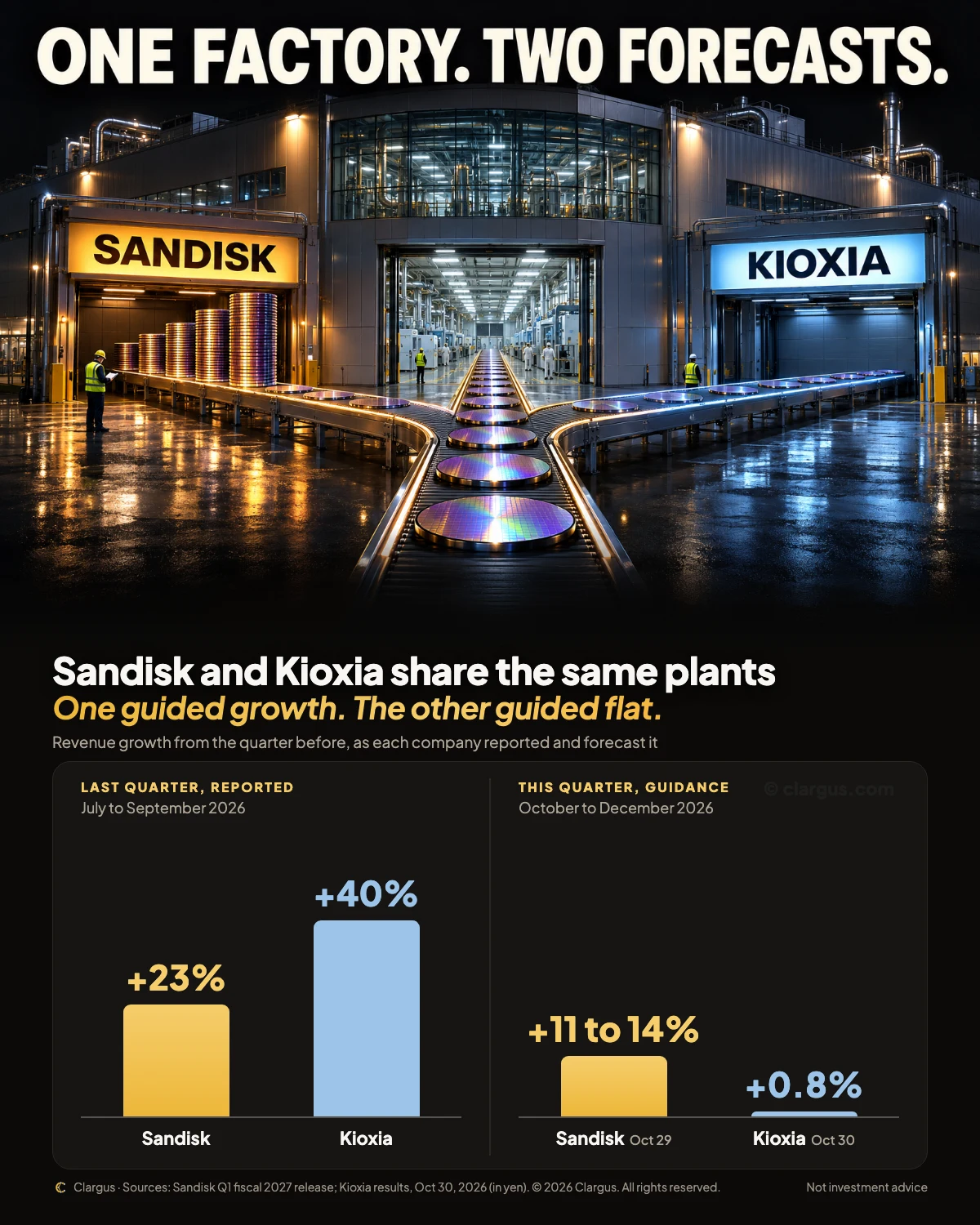
Sandisk (SNDK) began trading on a split-adjusted basis on November 20, 2026 after an 8-for-1 stock split, with the stock 43% below its level when the split was announced. One day after Sandisk forecast revenue growth of 11% to 14% for the December quarter, Kioxia, the Japanese partner whose joint ventures supply substantially all of Sandisk's wafers, forecast growth of 0.8%.
The two companies generally split the output of the same factories and sell the same product. Clargus mapped the connections around Sandisk and set the two forecasts side by side. Kioxia's flat forecast on October 30 was the first sign in this selloff that the surge in flash memory prices was fading, three weeks before TrendForce forecast lower contract prices for early 2027. The December-quarter reports, expected in late January and February, will show which forecast was right.
The deep dive
Why memory chips are in the spotlight
- AI data centers need large amounts of storage, and their buying has reshaped the flash memory market. Sandisk's 10-Q shows data center revenue up 1,685% from a year earlier, to $4.8 billion, on almost 330% more storage shipped at almost 320% more per gigabyte.
- Total revenue rose 378%, and gross margin rose by about 55 percentage points.
- Kioxia attributes its own growth to "strong demand from data center customers focusing on generative AI".
- Outside data centers the picture is different. Sandisk's phone, PC and device customers bought 20% less storage than a year earlier, and Kioxia says demand from smartphone and PC customers "is seeing a downward trend".
The split
- Announced October 29 with first-quarter results. Holders of record on November 9 received seven additional shares for each share, issued after the close on November 19. Trading on the new basis began November 20.
- The charter amendment took effect at 4:01 p.m. Eastern on November 19 and raised authorized shares from 450 million to 3.6 billion. Shares outstanding go from about 142 million to about 1.14 billion.
- The split was a board decision. It was not among the proposals at the November 17 annual meeting.
- Sandisk's stated reason: "to make stock more accessible, including to employees through its employee stock purchase plan".
- A split changes the number of shares and the price per share by the same factor. A holder's stake and the company's value are unchanged. The $755.16 close on November 19 equals $94.39 on the new basis. Guidance of $55 to $57 a share for the December quarter becomes about $6.88 to $7.13.
- The stock closed at $1,330.05 on announcement day.
The partner
- Sandisk's 10-Q: it "procures substantially all of its flash-based memory wafers from its business ventures with Kioxia". Its share "generally equals 50%" of the ventures' output, and it pays half of their fixed costs whatever it chooses to buy.
- Kioxia's results document says its revenue includes "sales to the Sandisk group recorded through its three manufacturing joint ventures".
Two forecasts, one day apart
| Sandisk | Kioxia | |
|---|---|---|
| Date | October 29 | October 30 |
| Revenue, July to September | $11.03 billion | 2,480.0 billion yen |
| Change from the quarter before | +23% | +40% |
| Forecast, October to December | $12.2 to $12.6 billion | 2,500.0 billion yen |
| Change from the quarter before | +11% to +14% | +0.8% |
- Kioxia: "While demand for data centers is expected to remain strong, factors such as the negative impact of exchange rates are expected to lead to revenue and profit for the third quarter being broadly in line with that of the second quarter."
- Kioxia also wrote that "demand from smartphone and PC customers is seeing a downward trend".
- Investing.com's report of Kioxia's results says it expects flat volume and a low single digit rise in average selling prices, after a rise in the mid-20s the quarter before, and a currency effect of minus 2% to 3%.
Why the forecasts can differ
- Currency. Kioxia reports in yen and Sandisk in dollars. Kioxia's own estimate of the currency effect explains a few points of the gap, not ten.
- Contracts. Sandisk said on its October 29 call that about half of its fiscal 2027 volume is under multi-year agreements.
- Mix. Sandisk's data center revenue rose 61% in the September quarter, to $4.8 billion. Its 10-Q shows phone, PC and device customers bought 20% less storage than a year earlier.
- Timing. Per Investing.com, Kioxia said some shipments were pulled into the September quarter and others slip into the following one.
Clargus's read: these explain why Sandisk can outgrow its partner for a quarter. They do not change the fact that both sell the same flash into the same market, where the direction of prices is now down.
What happened to the stock
- October 30: down 13.5%. Investing.com tied the fall to Kioxia's warning, weak Intel guidance and wider concern about AI stocks.
- November 4 and 5: down 7.9% and 22.3%, in a selloff of AI and chip stocks after the US midterm elections. Micron fell 17.5% on November 5.
- November 13: down 5.6% as chip stocks fell after Nvidia's chief executive left.
- November 16: down 8.6%. The next day GF Securities cut its flash price forecast and said Sandisk would have the most volatile earnings as the only pure flash maker of the group.
- November 19: TrendForce forecast contract prices down 0% to 5% in the first quarter of 2027, with all categories falling from the second quarter, and said spot prices had corrected by more than 20%. Sandisk was up 9% intraday and closed down 2.7%.
- From the June 25 closing high of $2,335.00 the stock is down 67.7%. Over the same period Micron is down 43%, Western Digital 56% and Seagate 49%.
What to watch
- Sandisk's fiscal second-quarter report, expected in late January 2027: revenue against the $12.2 to $12.6 billion forecast, and volume and price by end market.
- Kioxia's December-quarter report, expected in February 2027 (date not confirmed).
- TrendForce's first-quarter contract price updates.
What would challenge this
- Sandisk delivers inside its range while Kioxia comes in flat, with the difference explained by contracted data center volume. That would show the contracts doing what management says they do.
- Flash contract prices hold or rise in the first quarter of 2027.
How Clargus found it
Clargus mapped the connections around Sandisk in its knowledge graph. The heaviest ran to Kioxia: the wafer supply dependence, and a price warning dated October 30. Clargus then read both companies' documents for the same quarter.
Sources: Sandisk fiscal first quarter 2027 release (8-K, Exhibit 99.1, October 29, 2026); Sandisk Form 10-Q for the quarter ended October 2, 2026; Sandisk 8-K, November 19, 2026 (Item 5.03) and November 18, 2026 (Item 5.07); Kioxia Holdings, Consolidated Financial Results for the Six Months Ended September 30, 2026 (October 30, 2026); Investing.com, October 30, 2026; TrendForce, November 19, 2026; Seeking Alpha, November 17, 2026. Prices are daily closes.
What is the evidence?
| Claim | Date | Source |
|---|---|---|
| Sandisk fiscal Q1 2027 revenue $11,031 million, up 23% sequentially; fiscal Q2 revenue guidance $12.2 billion to $12.6 billion +11% to +14% | 2026-10-29 | Sandisk fiscal first quarter 2027 resultsCompany earnings release (8-K, Exhibit 99.1)Verified |
| Kioxia revenue 2,480.0 billion yen for July to September 2026, up from 1,767.1 billion; outlook for October to December 2026 of 2,500.0 billion yen, 'broadly in line with that of the second quarter', citing the negative impact of exchange rates +0.8% | 2026-10-30 | Kioxia Holdings, Consolidated Financial Results for the Six Months Ended September 30, 2026Company results documentVerified |
| Kioxia: 'demand from smartphone and PC customers is seeing a downward trend' while data center and enterprise demand increases | 2026-10-30 | Kioxia Holdings, Consolidated Financial ResultsCompany results documentVerified |
| Sandisk procures substantially all of its flash-based memory wafers from its ventures with Kioxia; its share generally equals 50% of output and it pays half of the ventures' fixed costs | 2026-10-30 | Sandisk Form 10-Q, quarter ended October 2, 2026SEC filing, Note 10Verified |
| Sandisk data center revenue up 1,685% year over year to $4,802 million; total revenue up 378%; Edge customers bought 20% less storage on an exabyte basis | 2026-10-30 | Sandisk Form 10-Q, quarter ended October 2, 2026SEC filing, MD&AVerified |
| 8-for-1 forward split: record date November 9, shares issued after the close on November 19, adjusted trading from November 20; stated reason is to make the stock more accessible, including to employees through the employee stock purchase plan | 2026-10-29 | Sandisk fiscal first quarter 2027 resultsCompany earnings release (8-K, Exhibit 99.1)Verified |
| Certificate of Amendment effective 4:01 p.m. Eastern on November 19, 2026; authorized common shares raised from 450,000,000 to 3,600,000,000 | 2026-11-19 | Sandisk Form 8-KSEC filing (8-K, Item 5.03)Verified |
| Sandisk closed at $1,330.05 on October 29, $1,150.89 on October 30 (down 13.5%) and $755.16 on November 19 (down 43.2%, $94.39 split-adjusted); down 67.7% from the June 25 closing high of $2,335.00 | 2026-11-19 | Clargus price dataDaily closing prices, computedClargus data |
| Kioxia expects flat bit shipments and a low single digit rise in average selling prices for October to December, after a mid-20s rise the quarter before | 2026-10-30 | Investing.comNews report of the company's resultsNot independently verified |
| NAND flash contract prices forecast to decline 0% to 5% in the first quarter of 2027, with all categories declining from the second quarter; spot prices corrected by more than 20% | 2026-11-19 | TrendForceResearch firm press releaseVerified |
| The strongest connection around Sandisk in the knowledge graph over 30 days runs to Kioxia: wafer supply dependence and a flash price warning dated October 30 | 2026-11-20 | Clargus knowledge graphKnowledge graph, entity connectionClargus data |
How are the companies connected?
Sandisk and Kioxia take the output of the same joint ventures and sell into the same market, but guided the same quarter very differently.
- Flash Ventures (joint plants in Japan)supplies substantially all wafers, generally 50% of output →Sandisk (SNDK)
- Flash Ventures (joint plants in Japan)other half of output →Kioxia
- Sandisk (SNDK)data center revenue +1,685% in a year →AI data center demand2026-10-30
- Kioxiasays smartphone and PC demand is trending down →Phone and PC demand2026-10-30
- Kioxiaflat guidance the day after Sandisk guided +11% to +14% →Sandisk (SNDK)2026-10-30
- TrendForce price forecastcontract prices forecast lower in early 2027 →Sandisk (SNDK)2026-11-19
What does it mean for investors?
The thesis
Two companies that share manufacturing gave forecasts more than ten points apart for the same quarter. The gap is a dated, checkable test of whether the AI-driven flash boom is still broad or is splitting between data center and consumer device demand.
The case against
Both forecasts can be right. Kioxia reports in yen and cites a currency drag; Sandisk has about half of its fiscal 2027 volume under multi-year contracts and a fast-growing data center business; Kioxia said shipments were pulled into the prior quarter.
Open questions
- Sandisk does not disclose its customers or contract prices
- Kioxia's own estimate of the currency effect comes from a news report of its results, not its filing
- The reasons given for each day's share price move come from news coverage, not from the companies
What to monitor
- Sandisk fiscal second-quarter results: revenue against $12.2 to $12.6 billion, volume and price by end market (2027-01)
- Kioxia October to December results (2027-02)
- TrendForce first-quarter 2027 contract price updates
What would prove this wrong?
Sandisk delivers inside its guided range while Kioxia comes in flat and the difference is explained by contracted data center volume, or flash contract prices hold or rise in the first half of 2027.
How was this insight made?
Data examined
- Sandisk SEC filings (8-K, 10-Q)
- Kioxia Holdings results document
- TrendForce press release
- Daily closing prices
- Clargus knowledge graph, 30 days of coverage
Approach
Clargus mapped the connections around Sandisk in its knowledge graph, found the heaviest ran to its manufacturing partner Kioxia, and then read both companies' own documents for the same quarter.
Limits
The comparison is between a dollar forecast and a yen forecast. A shared factory does not imply identical revenue growth. The post does not forecast that either company will miss.
Last checked:
© 2026 Clargus. All rights reserved. You may quote a short excerpt with a link to this page. Do not republish the full text, charts or images without written permission.
Add Clargus as a preferred source on GoogleSee Clargus insights more often in Google Top Stories.
Run this on your own names.
Each post started from an event in the graph, not a screen. In the beta, the same agents keep researching the names you hold and flag the next event in the chain.