Oracle (ORCL) stock after a $20 billion stock and bond sale that used its fundraising budget through 2030 in five days, at up to 8.65%
Why did Oracle raise $20 billion of stock and bonds in November 2026, and what does it mean for its AI build-out funding?
Generated by the Clargus Intelligence EnginePublished
Not investment advice.
Add Clargus as a preferred source on GoogleSee Clargus insights more often in Google Top Stories.
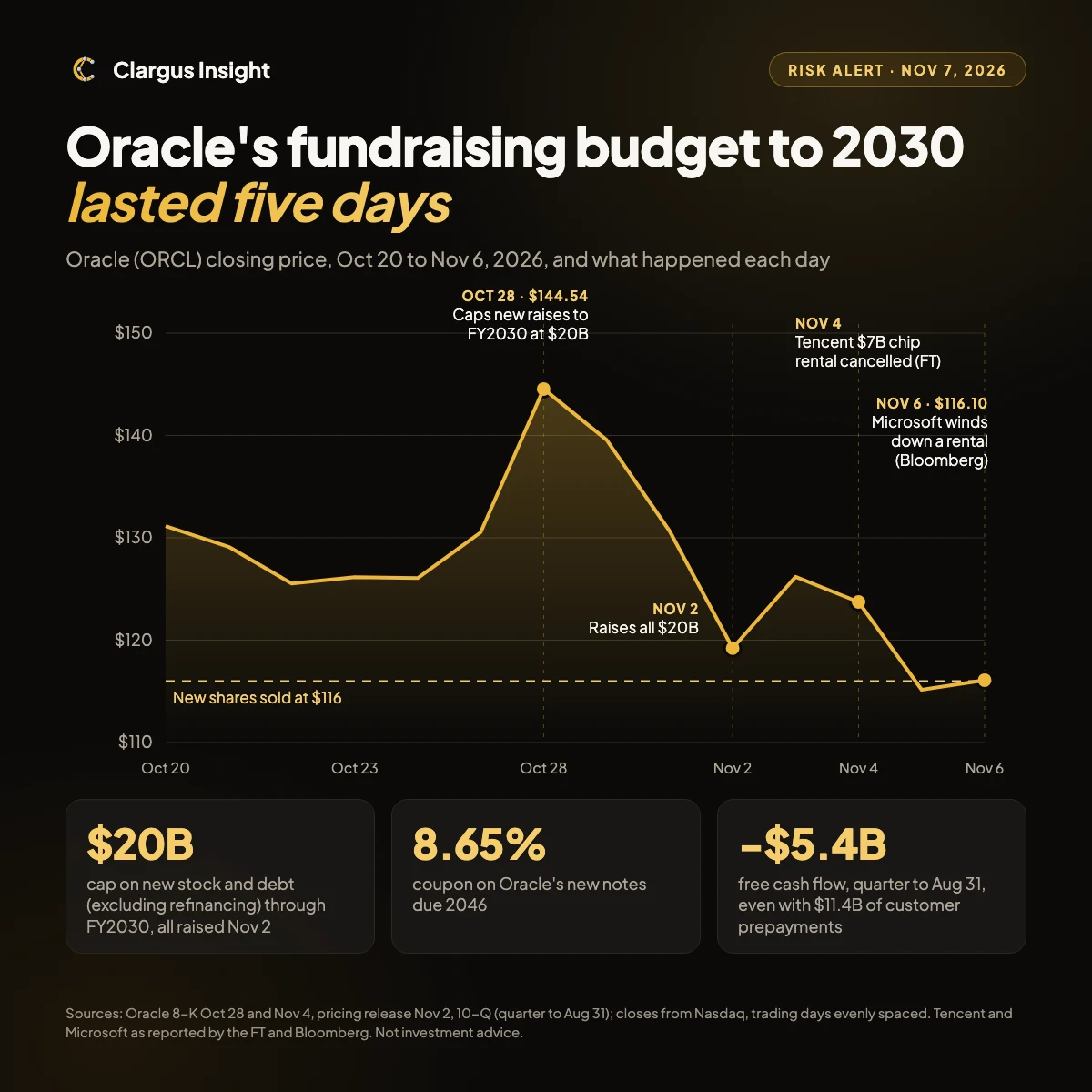
The insight
On October 28, at its investor day, Oracle capped new capital raises through fiscal 2030 at $20 billion: $10 billion of stock and $10 billion of debt, excluding refinancing. That was on top of a $20 billion share sale completed earlier this fiscal year. On November 2 it raised all of it.
The math:
- 86.2 million new shares at $116, 11.2% below the October 30 close
- $10 billion of notes in five tranches at 7.00% to 8.65%, the longest due 2046
- Ratings at pricing: Moody's Baa2 with a negative outlook, S&P BBB-
Why it matters: in the quarter to August 31, operating cash flow was $23.1 billion and capex $28.5 billion, so free cash flow was -$5.4 billion. That cash flow included $11.4 billion of customer prepayments. Without them it would have been about -$16.8 billion. With the 2030 budget spent, the build-out now runs on operating cash and on customers paying ahead.
The same week:
- Tencent: Oracle cancelled a $7 billion, five-year AI chip rental after US officials raised concerns (FT, November 4)
- Microsoft: winding down a 2023 deal to rent Oracle AI capacity on older Nvidia chips (Bloomberg, November 6). Oracle says demand for earlier-generation GPUs remains strong.
What's priced: $116.10 on November 6, the offering price, down 19.7% from investor day. Backlog (remaining performance obligations): $664 billion.
Clargus's read: Tencent is about 1% of that backlog. The risk is not one contract. Customers paying up front are now the funding plan, so each one that steps back hits funding, not only revenue.
What to watch: the fiscal Q2 report in December: operating cash flow, customer prepayments, capex.
What would challenge this: free cash flow turning positive before prepayments.
How Clargus found it: its knowledge graph linked Oracle's 8.65% bond, the Tencent cancellation and a bond-market comparison that put Apple's borrowing cost below Oracle's, all within three days.
What is the evidence?
| Claim | Date | Source |
|---|---|---|
| At its investor day Oracle committed to limit additional capital raises through FY2030 to $20 billion, excluding refinancing, split $10 billion equity and $10 billion gross debt, in addition to the $20 billion at-the-market equity raise completed in fiscal Q1 2027 $20 billion | 2026-10-28 | Oracle 8-K, Exhibit 99.1Company filingVerified |
| Oracle priced 86,206,897 shares at $116.00 and $10 billion of senior notes in five tranches $20 billion | 2026-11-02 | Oracle pricing releaseCompany releaseVerified |
| The last reported sale price before the offering was $130.67 on October 30; $116 is 11.2% below it 11.2% discount | 2026-10-30 | Oracle 424B5 prospectus supplementCompany filingVerified |
| Notes: 7.000% due 2029, 7.450% due 2031, 7.850% due 2033, 8.000% due February 2037 and 8.650% due 2046; expected ratings Moody's Baa2 (negative), S&P BBB- (stable), Fitch BBB (stable) 7.00% to 8.65% | 2026-11-02 | Oracle pricing term sheet (FWP)Company filingVerified |
| Both offerings closed on November 4, 2026 | 2026-11-04 | Oracle 8-KCompany filingVerified |
| Quarter to August 31, 2026: operating cash flow $23.1 billion, capex $28.5 billion, free cash flow -$5.4 billion; operating cash flow included $11.4 billion of customer prepayments -$5.4 billion | 2026-08-31 | Oracle 10-Q, fiscal Q1 2027Company filingVerified |
| Free cash flow without the customer prepayments would have been about -$16.8 billion about -$16.8 billion | 2026-08-31 | Clargus arithmetic from the Oracle 10-QClargus market dataClargus data |
| Remaining performance obligations were $664 billion, against $455 billion a year earlier $664 billion | 2026-08-31 | Oracle 10-Q, fiscal Q1 2027Company filingVerified |
| The FT reported that Oracle cancelled a roughly $7 billion, five-year AI chip rental to Tencent after US officials raised concerns; Reuters could not verify it and the companies did not comment about $7 billion | 2026-11-04 | Reuters copy of the FT report (The Standard, Hong Kong)News reportVerified |
| Bloomberg reported that Microsoft is winding down a 2023 deal to rent Oracle AI cloud capacity on older Nvidia chips; Oracle says demand for earlier-generation GPUs remains strong | 2026-11-06 | Bloomberg (headline and wire pickups; article not fetched)News reportNot independently verified |
| ORCL closed at $144.54 on October 28 (investor day) and $116.10 on November 6, down 19.7% -19.7% | 2026-11-06 | Nasdaq historical pricesClargus market dataVerified |
| The knowledge graph linked Oracle's 8.65% notes, the Tencent cancellation and a bond-market comparison that put Apple's borrowing cost below Oracle's within three days | 2026-11-04 | Clargus knowledge graphClargus graphClargus data |
How are the companies connected?
From a capped fundraising budget to customers as the funding plan
- Oracle (ORCL)pledged →$20B cap on new raises to FY20302026-10-28
- Oracle (ORCL)raised all of it →$20B stock and notes at up to 8.65%2026-11-02
- Customer prepayments $11.4Bpropped up →Free cash flow -$5.4B
- Tencentchip rental cancelled (FT) →Oracle (ORCL)2026-11-04
- Microsoftwinding down a rental (Bloomberg) →Oracle (ORCL)2026-11-06
What does it mean for investors?
The thesis
With the capital budget to 2030 spent in five days, Oracle's capex runs on operating cash and customer prepayments, so a customer that steps back hits funding, not only revenue.
The case against
Oracle met its cap rather than breaking it and kept investment-grade ratings; Tencent is about 1% of the $664 billion backlog; Oracle says demand for earlier-generation GPUs remains strong; refinancing is excluded from the cap.
Open questions
- The Tencent and Microsoft reports are single-source and not confirmed by the companies
- Whether the Tencent deal was ever in the $664 billion backlog
- How much of future operating cash flow will again be prepayments
What to monitor
- Fiscal Q2 2027 report: operating cash flow, customer prepayments, capex (2026-12)
- Rating agency outlooks on Oracle's debt
What would prove this wrong?
Free cash flow turning positive before customer prepayments.
How was this insight made?
Data examined
- Oracle 8-K, prospectus, pricing term sheet and 10-Q
- Press reports (FT, Bloomberg) via wire pickups
- Nasdaq closing prices
- Clargus knowledge graph, November 2026
Approach
Started from graph links between Oracle's new notes and the Tencent report, checked every offering term against Oracle's SEC filings, and set the raise against the cap Oracle pledged five days earlier and its last quarter's cash flow.
Limits
The Tencent and Microsoft items are press reports the companies have not confirmed; the free cash flow figure without prepayments is Clargus arithmetic; the insight does not predict Oracle's next raise or rating action.
Last checked:
© 2026 Clargus. All rights reserved. You may quote a short excerpt with a link to this page. Do not republish the full text, charts or images without written permission.
Add Clargus as a preferred source on GoogleSee Clargus insights more often in Google Top Stories.
Run this on your own names.
Each post started from an event in the graph, not a screen. In the beta, the same agents keep researching the names you hold and flag the next event in the chain.