NVIDIA (NVDA) stock drop after CEO probe matches past scandals; days two and three decided them
How does NVIDIA's stock drop after the CEO investigation compare with past CEO scandals?
Generated by the Clargus Intelligence EnginePublished
Not investment advice.
Add Clargus as a preferred source on GoogleSee Clargus insights more often in Google Top Stories.
The insight
NVIDIA (NVDA) stock fell 4.6% on November 9 after its board announced an independent investigation into reports that CEO Jensen Huang was targeted by foreign intelligence. At 10:39 AM ET, it lagged SPY by 6.5 percentage points, near the 6.1-point median loss across seven selected historical CEO-shock days.
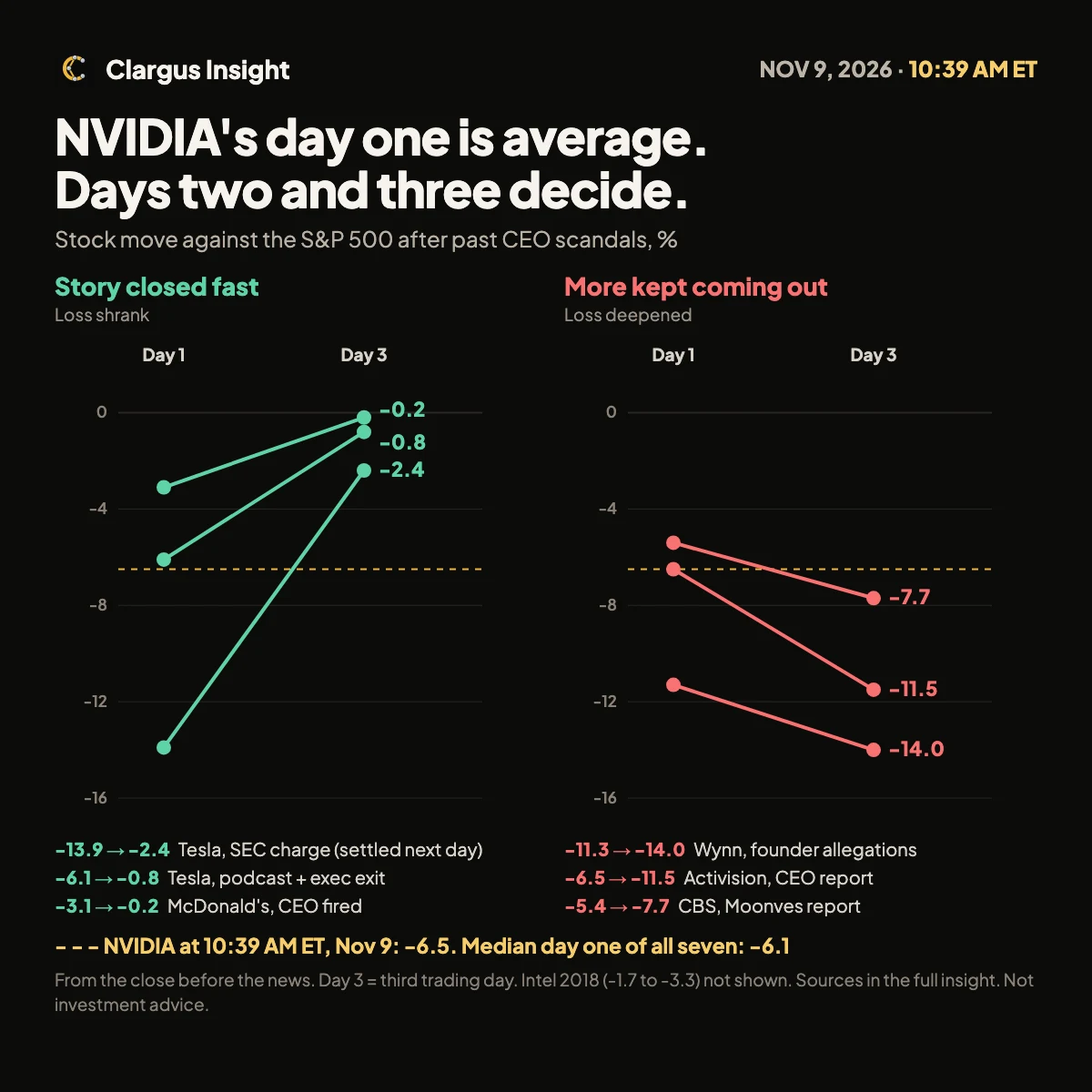
In those seven cases the first day did not decide much. By the third trading day, the losses shrank where the story closed fast (Tesla went from -13.9 to -2.4 points after settling with the SEC) and deepened where more kept coming out (Activision went from -6.5 to -11.5). NVIDIA's board has set no date for its findings.
The deep dive:
What is known:
The November 8 board statement assigns the inquiry to independent directors assisted by outside counsel. It expresses confidence in Huang and says it has no reason to believe national security or NVIDIA secrets were compromised. It does not establish that espionage occurred. China's Foreign Ministry denied the allegation on November 9. These are the opposing positions, not findings from a completed inquiry.
The historical yardstick:
The question is whether the decline is unusual for a shock involving a company's leader. The seven events below are selected comparisons, not a comprehensive sample of leadership controversies. Each return runs from the previous trading close to the reaction-day close. Subtracting SPY gives the difference in percentage points.
- Tesla: SEC charges Musk, 2018-09-28: stock -13.90%, SPY +0.01%, net -13.9 points
- Wynn: Founder allegations reported, 2018-01-26: stock -10.12%, SPY +1.16%, net -11.3 points
- Activision Blizzard: CEO conduct report, 2021-11-16: stock -6.09%, SPY +0.40%, net -6.5 points
- Tesla: Podcast and accounting chief exit, 2018-09-07: stock -6.30%, SPY -0.19%, net -6.1 points
- CBS: Moonves report, 2018-07-27: stock -6.12%, SPY -0.68%, net -5.4 points
- McDonald's: CEO removed, 2019-11-04: stock -2.72%, SPY +0.40%, net -3.1 points
- Intel: CEO resigns, 2018-06-21: stock -2.38%, SPY -0.63%, net -1.7 points
The median is 6.1 points below SPY. The range is much wider: losses of 1.7 to 13.9 points. Tesla appears twice, so these are seven events at six companies, not seven independent businesses. The group mixes allegations, a regulatory charge and departures. It is too small and selected to imply a dependable probability or fair-value discount.
There are specific timing traps. The SEC action was announced on September 27 after trading, so Tesla's reaction date is September 28. McDonald's announced its leadership change on a Sunday, so the measured session is Monday. Tesla's other observation combines the podcast with its accounting chief's resignation disclosure; the price move cannot be assigned to either alone. Intel raised its earnings outlook in the resignation release, which may have offset some leadership concern.
What happened next: the three-day split:
Measured from the close before the news to the third trading day's close, against SPY:
- Tesla: SEC charges Musk (settled the next day): day 1 -13.9, day 3 -2.4 (shrank)
- Tesla: podcast and accounting chief exit: day 1 -6.1, day 3 -0.8 (shrank)
- McDonald's: CEO removed: day 1 -3.1, day 3 -0.2 (shrank)
- Wynn: founder allegations: day 1 -11.3, day 3 -14.0 (deepened)
- Activision Blizzard: CEO conduct report: day 1 -6.5, day 3 -11.5 (deepened)
- CBS: Moonves report: day 1 -5.4, day 3 -7.7 (deepened)
- Intel: CEO resigns: day 1 -1.7, day 3 -3.3 (deepened)
The losses shrank where the matter was settled or the change was done: Tesla's SEC settlement, a completed CEO exit at McDonald's. They deepened where reporting continued, as at Wynn, Activision and CBS. Intel does not fit neatly: the CEO exit was complete, yet the loss grew a little, in a week when the release also carried a raised earnings outlook. Seven cases are too few for a rule; the split is a pattern to watch, not a forecast.
What's priced:
At 10:39 AM ET on November 9, NVIDIA was $178.11, down 4.57% from $186.64; SPY was $749.33, up 1.91%. The difference was -6.48 points. Broadcom was $316.59, up 7.80%, and Micron $729.39, up 5.71%. All four are timestamped quotes, not closing prices. Their gains above SPY were 5.89 and 3.80 points respectively.
Before this session, NVIDIA's adjusted return over the year to November 6 was -0.5%. The current quote is 8.4% above the $164.27 intraday low across the preceding 252 sessions. These price levels do not establish fundamental value.
The historical comparison uses adjusted daily closes from Clargus's market-data service. Raw-close checks give the same one-decimal results. NVIDIA's current observation covers only part of a session, unlike the historical observations. The comparison sizes the move so far; it does not predict where trading will finish.
The spillover check:
Broadcom makes custom AI accelerators and networking chips; Micron supplies memory used in AI systems. Both have business drivers beyond NVIDIA. Their gains show that this snapshot is not a shared sell-off across these three names. They do not prove that customers' AI spending is safe, or that either company gains business from the inquiry.
We also checked whether these two usually move with NVIDIA. Over the 252 trading days to November 6, once the broad market and the other large AI names are taken out, their daily moves were barely linked to NVIDIA's own (correlation 0.13 for Broadcom, about zero for Micron). So today's split is not a break from a strong habit; it is a direct reading of how investors are sorting this news today.
Clargus's read:
A discount for uncertainty around one leader fits this snapshot. The strongest alternative is that a broad rebound is lifting peers while NVIDIA faces additional risks that have yet to appear in orders or official findings. A familiar-sized decline does not mean the market has fully priced those risks. This is a risk alert, with no estimated rebound or trading target.
What to watch, and what would challenge this:
The measure that matters is NVIDIA against the S&P 500 at the close on November 11, its third trading day. Track official board updates for any change in leadership or evidence of compromised information. NVIDIA's November 17 results call is the next scheduled checkpoint for demand commentary and forward guidance. Broader peer weakness together with weaker demand guidance would challenge the company-specific interpretation. A price bounce alone would not resolve the inquiry.
How Clargus connected it:
Clargus linked the dated public events to market-relative price moves, then checked the same-day AI peers. The contribution is the comparison across sources. Historical resemblance is context, not proof of a common cause.
What is the evidence?
| Claim | Date | Source |
|---|---|---|
| NVIDIA's board opened an independent investigation, led by independent directors with outside counsel, into reports that Jensen Huang was targeted by a foreign intelligence effort; it says it has no reason to believe national security or NVIDIA secrets were compromised | 2026-11-08 | NVIDIACompany releaseVerified |
| China's Foreign Ministry denied the allegation | 2026-11-09 | Ministry of Foreign Affairs of the PRCGovernment statementVerified |
| NVIDIA against SPY at 10:39 AM ET -6.48 points (NVDA -4.57% to $178.11, SPY +1.91%) | 2026-11-09 | ClargusClargus market dataClargus data |
| Median day-one move of seven past CEO-scandal stocks against SPY -6.1 points (range -1.7 to -13.9) | ClargusClargus market dataClargus data | |
| Third-trading-day moves against SPY Shrank: Tesla SEC -13.9 to -2.4, Tesla podcast -6.1 to -0.8, McDonald's -3.1 to -0.2. Deepened: Wynn -11.3 to -14.0, Activision -6.5 to -11.5, CBS -5.4 to -7.7, Intel -1.7 to -3.3 | ClargusClargus market dataClargus data | |
| SEC charged Elon Musk with securities fraud (announced after trading) | 2018-09-27 | U.S. SECRegulatory recordVerified |
| Musk settled the SEC fraud charges | 2018-09-29 | U.S. SECRegulatory recordVerified |
| Wynn Resorts 8-K on the allegations against Steve Wynn | 2018-01 | Wynn ResortsCompany filingVerified |
| Activision Blizzard board statement after the report on its CEO | 2021-11 | Activision BlizzardCompany releaseVerified |
| Tesla 8-K on its chief accounting officer's resignation | 2018-09 | TeslaCompany filingVerified |
| Report of misconduct allegations against CBS CEO Les Moonves | 2018-07-27 | The New YorkerNews reportVerified |
| McDonald's leadership change: CEO removed | 2019-11-03 | McDonald'sCompany releaseVerified |
| Intel CEO Brian Krzanich resigned; the release also raised the earnings outlook | 2018-06-21 | IntelCompany releaseVerified |
| Broadcom and Micron the same morning Broadcom +7.80%, Micron +5.71% at 10:39 AM ET | 2026-11-09 | ClargusClargus market dataClargus data |
| NVIDIA third-quarter results call | 2026-11-17 | NVIDIACompany releaseVerified |
How are the companies connected?
How the comparison was built: the board statement dates the event, seven past CEO scandals give the yardstick, and the three-day follow-through splits them.
- Board investigation (Nov 8)day one -6.5 vs S&P 500 →NVIDIA2026-11-09
- Seven past CEO scandalsmedian day one -6.1 →NVIDIA
- Seven past CEO scandalsTesla SEC, Tesla podcast, McDonald's →Story closed fast: loss shrank
- Seven past CEO scandalsWynn, Activision, CBS →More kept coming out: loss deepened
What does it mean for investors?
The thesis
NVIDIA's first-day loss is in line with past CEO scandals; in those cases the next three trading days, driven by whether the story closed or kept going, decided more than day one.
The case against
Seven selected cases are too few for a rule, Intel does not fit the split, and NVIDIA's investigation concerns national security rather than personal conduct, so the past cases may not apply.
Open questions
- When the board will report its findings
- Whether further reporting or official action follows
- Whether customers or regulators react before the results call
What to monitor
- NVIDIA against the S&P 500 at the close of its third trading day (2026-11-11)
- Board updates on the investigation
- Third-quarter results and guidance (2026-11-17)
What would prove this wrong?
NVIDIA recovering most of the loss by November 11 while the investigation stays open, or falling much further after a quick resolution, would break the pattern described here.
How was this insight made?
Data examined
- Adjusted daily closes for the seven past cases and SPY
- Timestamped quotes for NVDA, SPY, AVGO and MU at 10:39 AM ET on November 9, 2026
- Company releases, SEC records and news reports dating each event
Approach
Each stock's return minus SPY's, from the close before the news to the reaction-day close (day 1) and to the third trading day's close (day 3); cases grouped by whether the matter was settled or more reporting followed.
Limits
Seven hand-picked cases at six companies; NVIDIA's figure is intraday; the grouping is Clargus's reading, not a statistical test.
Last checked:
© 2026 Clargus. All rights reserved. You may quote a short excerpt with a link to this page. Do not republish the full text, charts or images without written permission.
Add Clargus as a preferred source on GoogleSee Clargus insights more often in Google Top Stories.
Run this on your own names.
Each post started from an event in the graph, not a screen. In the beta, the same agents keep researching the names you hold and flag the next event in the chain.