SpaceX (SPCX) stock after the Artemis II ionosphere study, and the FAA review of 456 Starship launches a year that leaves out the upper atmosphere
Does the Artemis II ionosphere study matter for SpaceX's Starship launch plans?
Generated by the Clargus Intelligence EnginePublished
Not investment advice.
Add Clargus as a preferred source on GoogleSee Clargus insights more often in Google Top Stories.
The insight
SpaceX ($SPCX), the rocket and Starlink company, closed Thursday at $123.62, below its $135 IPO price. Its 12.5% drop this week came with the AI sell-off, not launches (CNBC). But its prospectus says "AI compute satellites at scale need full Starship reusability", so launch cadence is the number that carries the long case.
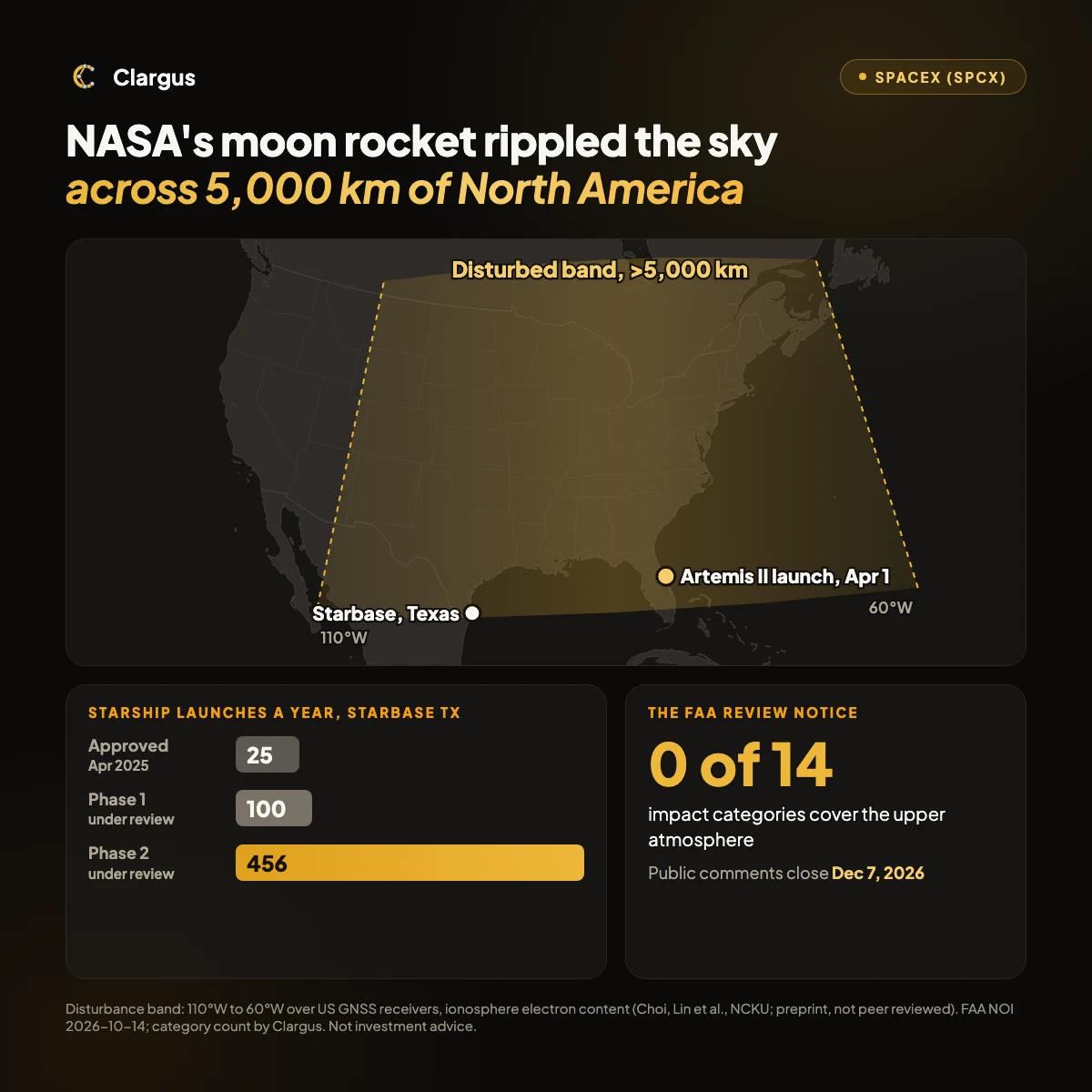
What the Artemis II study found: NASA's April 1 moon launch disturbed the ionosphere, the charged layer GPS signals pass through, from 110°W to 60°W, more than 5,000 km (preprint, National Cheng Kung University, not yet peer reviewed). The strongest ripple came from an engine burn about two hours after liftoff.
It is not the first rocket measured doing this:
- Falcon 9, 2017: a plasma hole about 900 km across (Space Weather, 2018)
- Starship Flight 2, 2023: disturbances 2,000 km long; that flight ended in explosions (Geophysical Research Letters, 2024)
The review: Starbase in Texas is approved for up to 25 Starship launches a year. On October 14 the FAA opened an environmental impact statement for up to 100, then up to 456. The notice lists 14 impact categories. None is the upper atmosphere (Clargus's count). Public comments close December 7.
Clargus's read: a comment period is where missing impacts get raised, and adding one can widen a review. We are not predicting that it will. For a stock whose case rests on cadence, it is a dated, public step few investors are watching.
What to watch: FAA scoping meetings on November 17 and 19, the December 7 comment close, and whether the draft review adds atmospheric effects.
What would challenge this: scoping closes with no new category, or SpaceX moves cadence to Florida, where launch pad 39A is approved for 44 Starship launches a year.
How Clargus found it: its knowledge graph picked up the Artemis study on November 5; checking it against the FAA's own notice surfaced the gap.
What is the evidence?
| Claim | Date | Source |
|---|---|---|
| Artemis II's disturbances span the longitudes of 110W to 60W, more than 5,000 km; the strongest followed an engine burn about two hours after liftoff, the ascent the weakest more than 5,000 km | 2026-10-01 | Choi, Lin et al., National Cheng Kung University (ESSOAr, submitted to GRL)Preprint, not peer reviewedVerified |
| A 2017 Falcon 9 launch left an ionospheric plasma hole about 900 km across ~900 km | 2018 | Space Weather, 2018Peer reviewedVerified |
| Starship Flight 2 in 2023 produced disturbances about 2,000 km long; the flight ended in explosions ~2,000 km | 2024 | Geophysical Research Letters, 2024Peer reviewedVerified |
| Starbase is approved for up to 25 Starship launches a year 25 | 2025-04 | FAA FONSI/RODFAA decisionVerified |
| The FAA opened an environmental impact statement for up to 100 (Phase 1) and up to 456 (Phase 2) Starship launches a year at Starbase; comments close December 7, 2026; scoping meetings November 17 and 19 100; 456 | 2026-10-14 | FAA notice of intent and Starship stakeholder pageFederal noticeVerified |
| The notice lists 14 impact categories; none is the upper atmosphere 0 of 14 | 2026-10-14 | Federal Register 2026-20963Clargus count of the notice's listVerified |
| LC-39A in Florida is approved for up to 44 Starship launches a year 44 | 2026-01-29 | Federal Register 2026-02108FAA record of decisionVerified |
| SpaceX's prospectus states AI compute satellites at scale need full Starship reusability and lists challenges to launch cadence as a risk | 2026-06-12 | SpaceX 424B4 prospectusSEC filingVerified |
| SPCX closed at $141.31 on November 3 and $123.62 on November 5, below its $135 IPO price; CNBC tied the drop to the AI and data-center sell-off -12.5% | 2026-11-05 | Nasdaq; CNBCExchange closes; reportingVerified |
| The knowledge graph linked Artemis II to the ionosphere in 105 mentions on November 5, 2026 105 | 2026-11-05 | Clargus knowledge graphClargus knowledge graphClargus data |
How are the companies connected?
From a NASA launch study to a dated SpaceX review step
- Artemis II launchmeasured →Ionosphere disturbed over 5,000 km2026-04-01
- Starship cadence 25 to 456 a yearunder review →FAA review notice, 0 of 14 categories2026-10-14
- FAA review notice, 0 of 14 categoriescomments close →SpaceX (SPCX)2026-12-07
- SpaceX (SPCX)AI satellites need Starship reusability →Starship cadence 25 to 456 a year
What does it mean for investors?
The thesis
Launch cadence carries SpaceX's long case, and the Starbase review omits the upper-atmosphere effect now measured three times; the comment period is where it can be raised.
The case against
Effects fade within hours and GPS impact is small; comment periods rarely change schedules; SpaceX can add cadence in Florida.
Open questions
- The Artemis study is a preprint
- Whether commenters raise atmospheric effects
- How the FAA scopes the draft review
What to monitor
- FAA scoping meetings (2026-11-17)
- Public comment close (2026-12-07)
- Draft environmental impact statement categories
What would prove this wrong?
Scoping closes with no new category, or SpaceX moves cadence to Florida, where LC-39A is approved for 44 Starship launches a year.
How was this insight made?
Data examined
- Clargus knowledge graph, November 2026
- Preprint and peer-reviewed papers
- FAA and Federal Register documents
- SEC filings
- Exchange closes
Approach
Followed the trending Artemis II story through the graph, checked the study against the preprint, found earlier measurements of SpaceX launches, and compared them with the impact categories in the FAA's Starbase notice.
Limits
The Artemis study is not peer reviewed; the category count is Clargus's reading of the notice; the post does not predict an FAA outcome.
Last checked:
© 2026 Clargus. All rights reserved. You may quote a short excerpt with a link to this page. Do not republish the full text, charts or images without written permission.
Add Clargus as a preferred source on GoogleSee Clargus insights more often in Google Top Stories.
Run this on your own names.
Each post started from an event in the graph, not a screen. In the beta, the same agents keep researching the names you hold and flag the next event in the chain.