Diebold Nixdorf (DBD) stock: the AI memory chip shortage just cut ATM margins
Why did Diebold Nixdorf stock fall, and how far have AI-driven memory chip costs spread beyond tech?
Generated by the Clargus Intelligence EnginePublished
Not investment advice.
Add Clargus as a preferred source on GoogleSee Clargus insights more often in Google Top Stories.
The insight
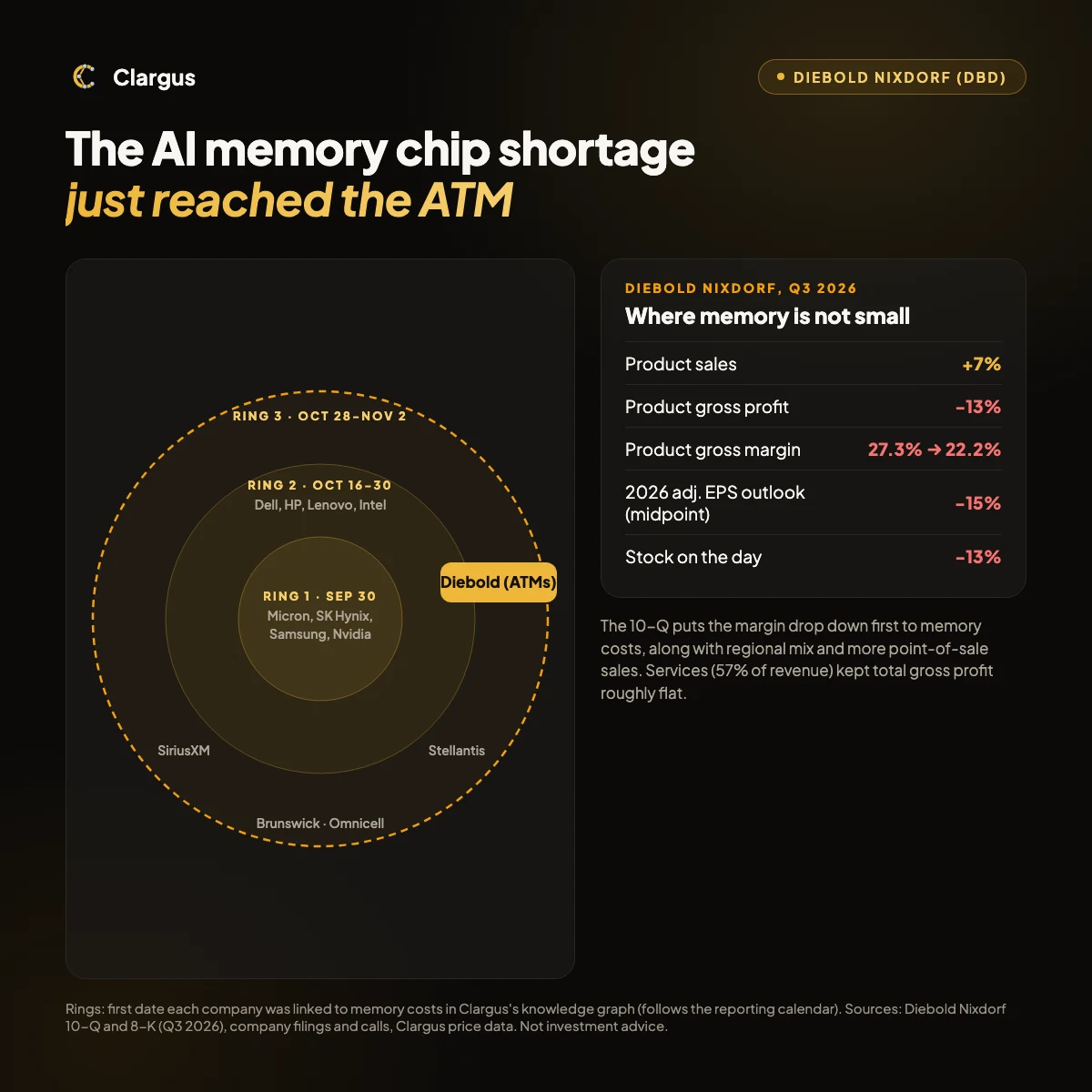
Diebold Nixdorf ($DBD), the ATM and point-of-sale maker, sold 7% more products in Q3 and made 13% less gross profit on them. Its 10-Q puts the margin drop down first to elevated memory costs. The stock fell 13% on the day it cut its 2026 earnings guidance.
Why it matters beyond one stock: Clargus mapped the companies its knowledge graph linked to memory chip costs over the past five weeks. They fall into three rings.
Ring 1 (from Sep 30): the chipmakers and AI platforms. Micron, SK Hynix, Samsung, Apple, Nvidia, Amazon.
Ring 2 (Oct 16 to 30): device makers. Dell, HP, Lenovo, Intel, Nintendo.
Ring 3 (Oct 28 to Nov 2): products far from any AI server. Jeep's parent Stellantis, SiriusXM's car radios, Brunswick's boats, Omnicell's hospital medication cabinets, Diebold Nixdorf's ATMs.
How it works: memory makers are shifting capacity toward server memory, driven by AI, so ordinary memory (DRAM) gets scarce. And ordinary memory sits inside almost anything with a screen or a radio.
For most of ring 3 the hit is small. SiriusXM says its equipment revenue fell 16% "primarily reflecting higher memory costs associated with our hardware modules", yet it raised its free cash flow guidance. Brunswick says memory is about 2% of costs at its marine electronics unit.
Diebold Nixdorf earnings, in numbers: product gross margin fell more than 5 points, to 22.2% from 27.3%, a drop its 10-Q puts down first to memory costs, along with regional mix and more point-of-sale sales. Products are 43% of revenue. The rest is services, whose margin rose and kept total gross profit roughly flat. Even so, Diebold cut its 2026 adjusted EPS outlook by about 15%, to $4.50 to $4.85 from $5.25 to $5.75.
Clargus's read: ring 3 is where memory turns into a margin story, and the size depends on two things: how much of the product is electronics, and whether contracts can be repriced. Diebold's filing says customer pricing actions already offset part of the decline. TrendForce forecasts conventional DRAM contract prices up 10 to 15% in Q4, a slower pace than earlier this year.
What would challenge this: memory price rises speed up again, or Diebold's product margin does not recover in Q4.
Dates show when each company first appeared linked to memory costs in Clargus's graph, which follows the reporting calendar.
What is the evidence?
| Claim | Date | Source |
|---|---|---|
| Diebold Nixdorf product net sales rose while product gross profit and margin fell in the third quarter Sales $429.3M vs $401.0M; gross profit $95.3M vs $109.3M; margin 22.2% vs 27.3% | 2026-09-30 | Diebold Nixdorf Q3 2026 Form 10-QCompany filingVerified |
| The product margin decline is primarily driven by elevated memory costs, an unfavorable regional mix of Banking product sales and a higher share of electronic point-of-sale sales, partly offset by tariff recoveries and customer pricing actions | 2026-09-30 | Diebold Nixdorf Q3 2026 Form 10-Q, MD&ACompany filingVerified |
| Services margin rose and total gross profit was roughly flat Services gross margin 26.9% vs 25.0%; total gross profit $247.2M vs $245.1M | 2026-09-30 | Diebold Nixdorf Q3 2026 Form 10-QCompany filingVerified |
| Diebold Nixdorf cut its full-year 2026 outlook Adjusted EPS $4.50 to $4.85 (was $5.25 to $5.75); adjusted EBITDA $490M to $510M (was $510M to $535M) | 2026-10-28 | Diebold Nixdorf Q3 2026 earnings release (SEC exhibit 99.1)Company releaseVerified |
| Diebold Nixdorf share price on the day of the report $66.68 to $58.07 (-12.9%) | 2026-10-28 | Clargus end-of-day pricesClargus market dataClargus data |
| SiriusXM equipment revenue fell, primarily reflecting higher memory costs associated with its hardware modules; 2026 free cash flow guidance was raised Equipment revenue $36M vs $43M; FCF guidance about $1.40B | 2026-10-29 | SiriusXM Q3 2026 earnings release (SEC 8-K)Company releaseVerified |
| Omnicell expects about $6 million of incremental memory and related component costs in the second half of 2026, about half in the third quarter ~$6M | 2026-10-29 | Omnicell Q3 2026 earnings call transcript (The Motley Fool)Company releaseVerified |
| Stellantis' fourth-quarter guidance includes incremental cost headwinds from memory chips and recall costs | 2026-10-28 | Stellantis Q3 2026 shipments and revenues release (SEC 6-K)Company releaseVerified |
| Brunswick named memory alongside aluminum and copper as material inflation; memory is about 2% of costs at its Navico Group marine electronics unit | 2026-10-29 | Brunswick Q3 2026 earnings call transcriptCompany releaseVerified |
| Conventional DRAM contract prices are forecast to rise 10 to 15% quarter on quarter in 4Q26, as suppliers keep shifting capacity toward server products +10 to 15% (forecast) | 2026-09-30 | TrendForce press releaseNews reportVerified |
| First date each company appeared linked to memory chip costs in the graph: chipmakers and AI platforms from September 30, device makers October 16 to 30, Stellantis, SiriusXM, Omnicell, Brunswick and Diebold October 28 to November 2 | 2026-11-04 | Clargus knowledge graph, relationships mentioning memory costs, 2026-09-30 to 2026-11-04Clargus graphClargus data |
How are the companies connected?
How AI demand for server memory reaches an ATM maker's margin.
- AI server demandpulls capacity away from →Ordinary memory (DRAM) supply
- Ordinary memory (DRAM) supplylinked to memory costs from →Ring 1: chipmakers and AI platforms2026-09-30
- Ordinary memory (DRAM) supplyraises costs at →Ring 2: device makers2026-10-16
- Ordinary memory (DRAM) supplynamed as a cost by →Ring 3: Stellantis, SiriusXM, Brunswick, Omnicell2026-10-28
- Ordinary memory (DRAM) supplycut product gross margin at →Diebold Nixdorf (ATMs, point of sale)2026-10-28
What does it mean for investors?
The thesis
In products far from AI servers, memory turns into a margin story where electronics are a large share of the product and contracts cannot be repriced quickly; Diebold is the visible case.
The case against
For most of the outer ring the cost is small (SiriusXM raised guidance; memory is about 2% of costs at Brunswick's electronics unit), Diebold's services business kept total gross profit flat, its pricing actions already offset part of the decline, its outlook cut also reflects revenue mix and raw materials, and TrendForce expects memory price rises to slow in Q4.
Open questions
- The memory price path into 2027
- How quickly Diebold can reprice contracts
- Whether more non-tech companies name memory costs in fourth-quarter guidance
What to monitor
- TrendForce first-quarter 2027 contract price forecast (2026-12-31)
- Diebold Nixdorf fourth-quarter product gross margin (2027-02-28)
- Stellantis full-year 2026 results, memory cost line
What would prove this wrong?
Memory price rises speed up again, or Diebold's product gross margin does not recover in the fourth quarter.
How was this insight made?
Data examined
- Clargus knowledge graph: relationships mentioning memory chip costs, 2026-09-30 to 2026-11-04, with the first date each company appeared
- Each company link traced to its source article (call transcripts, earnings releases)
- Primary sources checked 2026-11-04: Diebold Nixdorf 10-Q and earnings release, SiriusXM 8-K, Stellantis 6-K, Omnicell transcript, TrendForce release
- Clargus end-of-day price data
Approach
The run listed every company the graph connected to memory chip costs in the window and ordered them by the first date the link appeared, which grouped them into chipmakers, device makers and products far from AI servers. Each outer-ring link was traced to the company's own words, and Diebold Nixdorf's filing supplied the size of the effect.
Limits
The ring order partly follows the reporting calendar, since companies are linked when they report. The graph's update tables start on 2026-09-01, so the analysis does not claim the outer ring is new this quarter (Omnicell said it discussed memory costs last quarter). The read on margins is Clargus's inference.
Last checked:
© 2026 Clargus. All rights reserved. You may quote a short excerpt with a link to this page. Do not republish the full text, charts or images without written permission.
Add Clargus as a preferred source on GoogleSee Clargus insights more often in Google Top Stories.
Run this on your own names.
Each post started from an event in the graph, not a screen. In the beta, the same agents keep researching the names you hold and flag the next event in the chain.